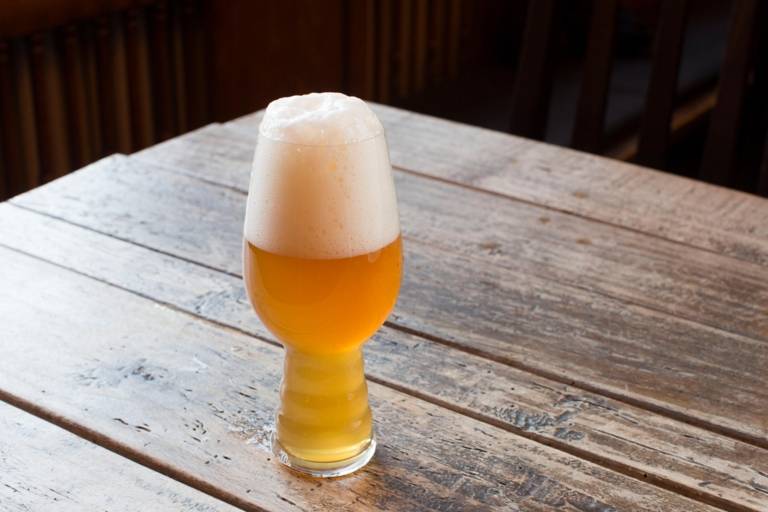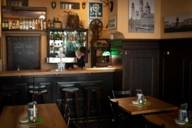
A freshly tapped Halbe (half-litre of beer), a table, good company and conversations that grow ever more absurd: Why Bavarian pubs remain the last truly functioning place of resonance.
There is a saying that perfectly sums up the Bavarian spirit: “The mountains from below; the church from the outside; the pub from the inside!” Of course, Bavarians appreciate their Alpine scenery. But this restless urge to charge up mountains is actually an invention of the newcomers. And, obviously, the church is respected for the sense of order it provides and for its pastoral care. But to be honest, the closing words “Go in peace” are usually the moment everyone is waiting for. The only place where Bavarians truly want to be is the pub. It is both a fundamental part of the Bavarian mindset and – during those unfortunate hours spent elsewhere – a place of longing. And outside Bavaria, it is an institution whose purpose and unwritten rules often require some explanation.
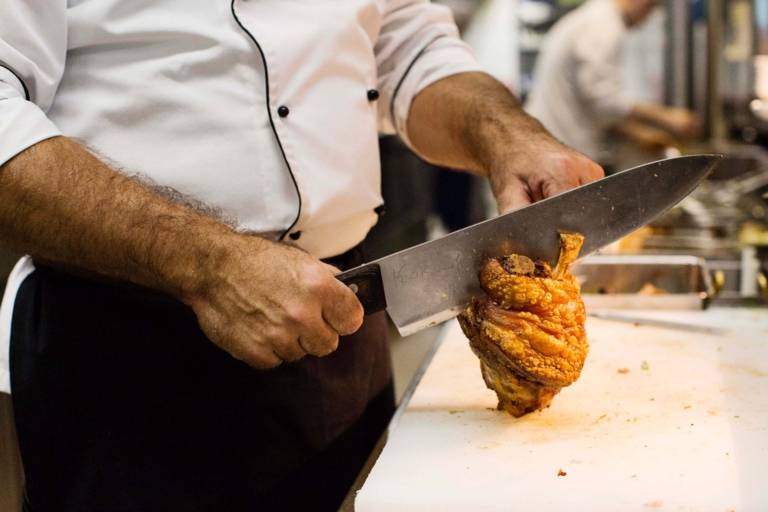
First and foremost, you should never confuse a Bavarian pub with a restaurant. Of course, food does play a role in pubs as well. However, the menu is usually limited to a handful of dishes, chief among them roast pork, which is traditionally served on Sunday afternoons. In Munich’s larger, traditional pubs, this is complemented by specialities from the ‘Kesselküche’ (kettle-style cooking), such as ‘Tellerfleisch’ (boiled beef), offal and ‘Selchfleisch’ (smoked meats). A pub with an excellent reputation is, of course, also judged by the quality of its food. But cuisine always plays second fiddle.
The real focus is on the beer. And that creates a unique sense of community. If you go to a restaurant, you want to eat. And usually in a fixed group that keeps to itself. In a restaurant, it is the exception rather than the rule to exchange more than a fleeting glance with guests at another table. A pub – or, in its purest form, a taproom – is quite different. You enter this social space as an individual – even if you arrive as part of a group. And above all, this means: You never drink alone. This drinking, this special form of socialising, follows a rhythm all of its own.
At first glance, the pub might seem like a rather rough place. The serving staff speak in a brusque manner (“Wissma's scho?” “Know what you want? Ready to order?”), while the regulars eye up newcomers. But how wrong it would be to interpret this as hostility. For the pub's fundamental law, the rule that always takes precedence, like the Eichel-Ober (ace of hearts) in the card game Schafkopf, is the familiar invitation “Hock di hera, samma mehra” – come and sit with us, the more the merrier.
While in restaurants it can feel like a minor affront to ask people who are already seated if there's a spare place at the table (often this is granted, but only with some reluctance), in the pub there is virtually an unspoken obligation to pull up a chair. This instinctive openness to newcomers among those sitting in the pub already, is not entirely selfless. It is driven by a very practical interest: The more people there are in the room, the more opportunities for conversation arise and the more gemütlich it becomes – which in Bavaria roughly means: the more interesting it gets. Beer calls for interaction. Drinking alone is no fun; nothing good comes of it.
Conversation is better, healthier and, above all, more entertaining. As the beer consumption rises, conversations inevitably grow louder as well (almost out of necessity, since everyone else in the room is getting louder, too), so that newcomers quickly catch on to what's being discussed. Brief eye contact, followed by a casual “Right? Don't you agree?”, is enough to draw them into the conversation. And because these invitations are extended in all directions, the guests soon find themselves swept up in a gentle flow of different conversations.
While in restaurants it can feel like a minor affront to ask people who are already seated if there's a spare place at the table, in the pub there is virtually an unspoken obligation to pull up a chair.
Even those who do not drink alcohol – or who stick to alcohol-free beer – cannot help being carried along by the atmosphere. The mood is so exuberant that even the completely sober feel a certain sense of intoxication. Yet some topics stand firm like rocks against the tide: stories about overzealous bureaucracy (“A bowling alley had to shut down recently because it didn't have an emergency exit.” – “Oh come on, what nonsense!”), Bayern Munich and TSV 1860 football clubs, as well as cyclists racing far too fast along the banks of the Isar river. What sociologist Hartmut Rosa calls “resonance” – that state in which people stop fighting against the world around them and begin to move in harmony with it – is nowhere easier to achieve than in a Bavarian pub.
This general vibe is not only evident among the guests, but also, as the evening progresses, between the guests and waiting staff. The waiters are the ultimate authority in the pub; they have everything under control and their word is law. You soon realise that behind their apparent gruffness lies nothing more than the need to make themselves heard. And the later it gets, the smoother communication with the staff becomes. At its highest level, all it takes is a simple exchange of glances – and the next drink is already on its way.
Herbert Achternbusch, painter, film maker and one of the most unconventional minds Munich has ever produced, spent his life sitting in the Weißes Bräuhaus on Tal. There, he waited for inspiration. He harboured a deep and sincere affection for the waiting staff. His notes on them: “I am always amazed to spot one of my waitresses in civilian clothes in the crowds on Tal Street. Just as men in public office become puffed up, the waitresses become more beautiful whilst at work, framed by their black-and-white uniforms – proud crows and joking magpies, moving through the dense gathering of guests.”
The pub draws everyone who works and sits within it into a peculiar kind of community – one that needs no explanation, issues no invitation and yet welcomes anyone who takes a seat. At some point, the boundaries between the tables begin to dissolve. No one can exactly pinpoint when this happens. But at some stage in the evening, the room falls quiet. This gradual fading into silence is the logical next step in the pub’s ritual. It should not, however, be mistaken as a resignation. Nor is it total silence; it is occasionally interrupted by a softly sighed “Ja mei” – “oh well” – which in turn should not be misinterpreted as a lament. Rather, it is the expression of a state of mutual agreement.
In this way, it resembles a condition understood in Far Eastern Zen philosophy as one of the highest forms of existence: a state in which the mind no longer clings to individual things. Mushin – literally: “no mind, no heart” – describes a radically open state. A consciousness that receives without clinging. Or as the pre-Socratics put it: panta rhei – everything flows. From a spiritual perspective, it is not far-fetched that this state of gentle, but lasting affirmation is repeatedly associated with paradise. The finest example, of course, in Ludwig Thoma's Ein Münchner im Himmel (A Munich Man in Heaven), in which the afterlife is – quite logically – swapped for a Mass (a litre of beer).
The pub draws everyone who works and sits within it into a peculiar kind of community – one that needs no explanation, issues no invitation and yet welcomes anyone who takes a seat. At some point, the boundaries between the tables begin to dissolve.
God himself instructs the angel Aloisius to deliver a message to the Bavarian Minister of Culture. Aloisius takes off. But: “And, in keeping with an old habit, his path led him to the Hofbräuhaus (beer hall), and he found his usual seat again, found it empty and waitress Kathi came up to him and he ordered a Mass, and then another Mass, and he forgot his letter and his mission, and ordered another Mass and yet another, and he is still sitting there today.” In Bavaria and Munich, this kind of faith makes perfect sense. What else could one possibly imagine? Or, to express it using a quote by Achternbusch: “I find an evening without a pub godless.”